Saturday, May 11, 2013

Yellow Headed Black-Bird


DesertDale is at it once again.  This time it is the "Yellow Headed Black-Bird."  They stay in the western  marshes in the summer time.  Outside
the nesting season, they wander in flocks in open habitats , like open farm fields, feed lots an the prairies.
 
 
The name describes the male, who has a white wing patch . DesertDale said they have a very nice song.
 Female are smaller, sooty, brown, with no white wing patch, if they do it is very hard to see .
Their range from April to October Nevada and Utah.  Sept.- April Arizona and New Mexico.
 
Enjoy the photos.  Kitfoxgal

Thursday, May 9, 2013

Long-bill Dowitcher

The Long-bill Dowitcher are a medium size, chunky, dark shorebird.  They have long, straight bill and pale eyebrows.  They feed in mud or shallow water.
 
They prop their heads with a rapid jobbing motion.  When they fly a white wedge from  berried tail to middle of the back. They prefer the freshwater.  At times they have been seen in coastal estuaries.
They feed on insects and other invertebrates, and seeds.
 
Males gather    in spring on "leks" and display to attract females.  Females visits lek , then mates with one of the males.  The male  takes no part in caring for the eggs or the young. The female lay about 4 eggs.  It takes 20 to 23 days for the eggs to hatch.

This is a Short-bill Dowitcher that DesertDale took at the ocean, when we were there last June.  The short-bill are a only a shore bird.

Enjoy the posting.  Kitfoxgal

Tuesday, May 7, 2013

Sandhill Crane In Florida

 "Sandhill Crane"
The adults are mostly gray with rusty blotching on neck, body, and upperwing coverts.  The nekefore crown are a dark red, with amber eyes.  Their neck are long and thin,  bill is short, thin, straight and black.  Legs long and black.
 
They do fly with   their neck outstretched.  Summer they are in shallow marshes; winter they follow fields , salt flats.
They are very social, may be in large flocks in some places and absent elsewhere.  
 
They net in around marshes.  At migration time and winter they sometime feed on waste grain in open fields.
The Platte River in Nebraska is one of the great wildlife spectacles in North America.

Beauty of a bird.  These photos were taken by no-other then DesertDale.   Kitfoxgal


Monday, May 6, 2013

Cinnamaon Teal


 Cinnamon Teals are a small colorful duck.  They are found in ponds throughout the American West.  They are the only duck with separate breeding populations in North and South America.  They like freshwater seasonal and semiperment wetlands, like marshes, reservoirs, sluggish streams, ditches and stock ponds.

The males are much more colorful.
The female's are a little longer.  Plus the females line through the eye is less distinct.
They do migrate, as they avoid the cold weather more then most ducks.  Many males in fall still wear drab eclipse plumage, looking much like females except for their red eyes.

Their are found in Southwest  Canada, west United States, Mexico and South America.

Enjoy the photo's by DesertDale (The Birdman)
Kitfoxgal

Saturday, May 4, 2013

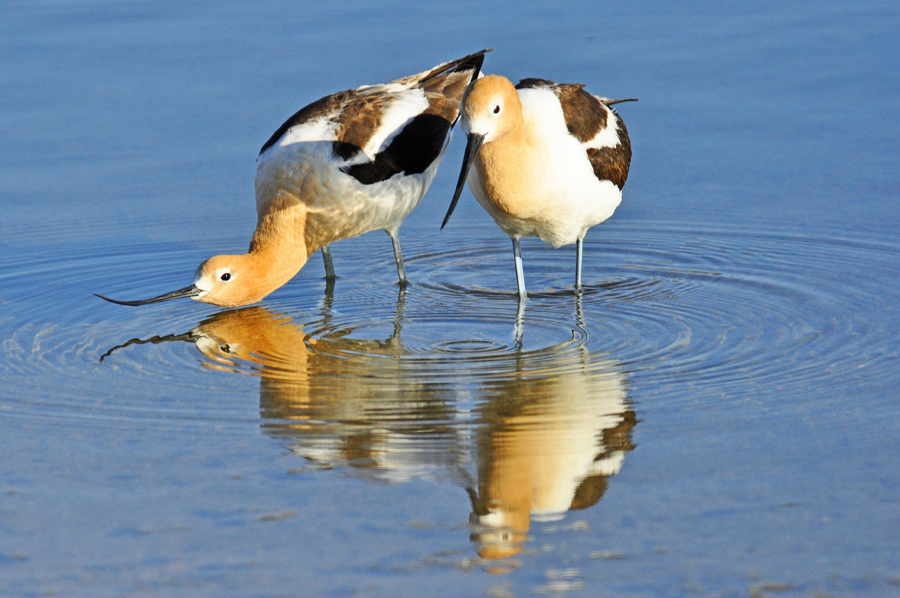
Avocent At Fish Lake Valley

The Avocent is one beautiful bird.  They are a shorebird .  They are black with scapular stripes on their upper part.   White underparts, black & white wings.  They have a long thin bill that is curved.
 The males bills are longer and straighter then the females.  When they feed they sweep their bill from side to side.
They make a loud, piercing wheep or a peeping sound.   When agitated it is a higher pitched.
 
They nest in colonies.  Often seen near Black-necked Stilts.

Enjoy.  Kitfoxgal

Friday, May 3, 2013

Roseate Spoonbill

The "Roseate Spoonbill"  DesertDale took in Florida this year.  They have pink and red plumage that makes them one of the most colorful wading birds.  They have a large ,flat, spoon-shaped bill.  With their wing and back are pink.  Both sexes are alike.  Their heads are featherless , yellow or greenish gray with black collar.  Their bill are a grayish with black markings. Their  eyes, legs and feet are reddish.  Neck and upper back are white with a red patch on breast , lower back pink; rump red  and tail orange.. Wings pink with a wide red carpal.
 
 
They are seen rarely inland. They winter in Florida, Louisiana and Texas.   They are seen in the Gulf and the South Atlantic coasts.
 
They are similar the  flamingos.  Their voices are silent except at breeding time, then it is very low.
 
Beauty of a bird.  Kitfoxgal  

Wednesday, May 1, 2013

Crested Caracara Caracara

 
This is a "Crested Caracara" photo that DesertDale took when we were in Florida this year.  It is a large, long-legged raptor. A member of the falcon family that looks a hawk and eats like a vulture.   Their wing almost reach to it's tail tip.
They feed on carrion (decaying flesh) and small prey. They soar in the sky like other hawks and vultures.   Their wings, body and crown are black.  Their face and neck are white.  Upper  breast and back are white, with a few black feather mixed in.  Tail is white with dark barring and dark terminal band.  Facial skin and cere are  orange.  Legs are yellow.  Their voice is silent , that is most of time.
They live in Central Florida and along the coast of Texas.  Plus a small section of south-east Arizona.
They generally do not migrate.
They are stable in Florida and Arizona.  They are expanding in Texas.
                                                                 (  This photo from goggle.)
Enjoy.                 Kitfoxgal